

Pays d’Auge · Normandy
Lowline breeding
We raise and select 60 Lowline with care.
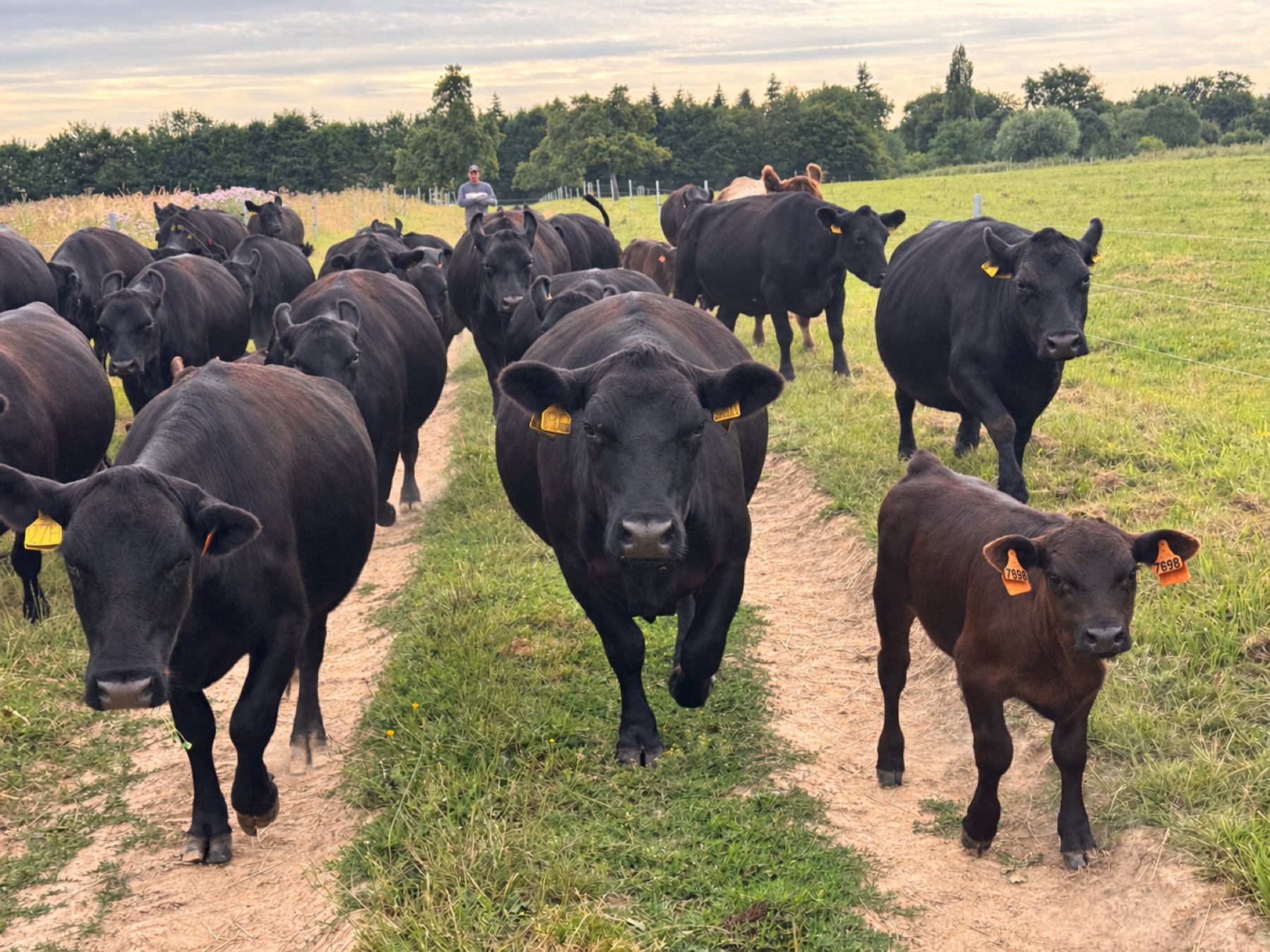
An exceptional breed.
The Lowline story begins far from Normandy’s hedgerows, in Trangie, Australia. There, in 1974, an Aberdeen Angus herd founded on stock from leading studs became the starting point for research into cattle growth.
Over the generations, a smaller-framed line emerged: the Low line (literally, the lower line). Descended from this closed herd, it preserved the Angus identity in a more compact form. In 1992, the Australian association was formed and the Australian Lowline breed was officially named.
A more compact frame, with other strengths:
- A generally docile temperament and easier handling.
- Naturally hornless cattle.
- Efficient use of grass and forage.
- Small calves at birth, supporting ease of calving.
At Montalouveau, that story has continued since 2019. Our passion is to raise these distinctive cattle, preserve their origins and take the time to know them.
A commitment to selection.
A small black cow is not necessarily a Lowline. A fullblood Lowline must have two registered Lowline parents, with parentage verifiable through DNA.
All our Lowline cattle are registered in the Canadian Lowline herdbook. Their DNA-verified parentage traces back to the foundation herd: a documented history that follows each animal.
We select for conformation and temperament, paying attention to a balanced animal and ease of handling. Your breeding goals then guide the choice of breeding stock we present to you.
Grass, hay and hedgerows.
In the Pays d’Auge, between sea, forest and hedgerows, our 60-head herd lives to the rhythm of Normandy’s pastures. They eat only grass, with hay in January, February and March, and no supplementary feed.
Close contact is part of how we raise our cattle: we gradually introduce the whole herd to the halter, building trust and making everyday care easier.
What should you know about Lowline?
Do they calve easily?
The breed is known for easy calving. Our Lowline usually calve outdoors in spring, without assistance. Appropriate care and monitoring remain important.
What fences do we use?
At Montalouveau, our Lowline respect the electric fences they are accustomed to, installed at about 80 cm to 1 m high, with a voltage between 6,000 and 8,000 volts. This is our farm practice; fencing must be suited to the animals and the land.
Are they used to a halter?
We gradually halter-train the whole herd. We explain each animal’s skills and temperament individually: not every animal is at the same stage.
What should you prepare before they arrive?
Well-managed pasture, available water, maintained fences and at least two cattle for companionship. Lowline are raised outdoors in countries including Australia and England. Shelter needs depend on the fields; if they are too wet, a shelter with a dry area may be preferable. Let’s discuss your land, ground conditions and hay reserves.
Further reading: Australian Lowline Cattle Association · Canadian Lowline Cattle Association.